28 ARTISTS & JOURNALISTS
their work and words, interviews, blogs, images, hints, tips, websites
and more...

Showing posts with label Roz Stendahl. Show all posts

Wednesday, December 30, 2015

News from Roz Stendahl: What I'm Looking Forward to in 2016

Left: 15 minute sketch at life drawing—costumed model at the co-op. Color pencil. Click on the image to view an enlargement.

Each year brings new challenges and currently I am excited about the new online classes I’m going to be bringing out in 2016.

But as the new year starts I’m most looking forward to a new offering of my "Drawing Practice: Drawing Live Subjects in Public" class.

Each day from January 31 through March 5, 2016, I’ll be in the class looking at student work, answering questions, and helping the students build a durable daily sketching habit. 

We will begin with a strong foundation and lots of skill building demonstrations and assignments. These include sketching demonstrations made at Como Zoo and the 2014 Minnesota State Fair. (It doesn't get more public than the Fair!) New lessons come every Monday and Thursday throughout the month.

We will add sketch out dates to build a tolerance for working in public with moving subjects. And through it all I’ll be helping students silence their internal critics, make friends with their editing eye, and learn a new way to talk about their artwork that is positive, honest, and supportive. My month-long involvement with the class wraps up with strategies for goal setting. The class includes two live webinars during the first month. Students have access to all the videos and the classroom for a full year. And there are quarterly live webinar check-ins throughout the year so that they keep their daily drawing practice going.

I’ve been teaching a version of this class live for about 15 years. In 2015 I went online with this class. I was overjoyed with the response. Students from around the world joined with me to work on their sketching and observational skills. They dug deep and worked on longstanding issues of resistance and procrastination that were holding them back. They created amazing work and supported themselves and their fellow students in their creative journey.

In over 25 years of teaching, I’ve heard every excuse and seen every type of resistance there is. Nothing is more gratifying to me as a teacher than helping students break through the barriers that hold their drawing practice stagnant.

While this is an immensely rewarding class to teach, the intense teaching involvement and feedback I provide means I can only offer this class once a year. I believe that by offering it at the beginning of the year I will be able to help students start out strongly.

And by offering the class at this time of the year I won’t have it run right up to the Minnesota State Fair like it did last year! (I wanted students to finish lessons before the Fair, but by running the class in February they will also be able to practice for several months, should they elect to go the Fair. And you all know I believe everyone should come to the Minnesota State Fair.)

This means that I’ll also be able to focus on the new classes I’m filming and still get to the Fair myself. The new classes cover bookbinding methods, art journaling techniques, and a design class.

Left: Finch sketches made at the nursing home Aviary. Sakura Pigma Sensei Pen on Rives Lightweight. Click on the image to view an enlargement.

I appreciate the interest this blog’s community has taken in my move to online teaching. I’m grateful for the hard work that Kate Johnson has done to create this community and encourage people to share their work. She makes it look easy.

I will still be blogging here and on Roz Wound Up. And I hope also to post additional videos on YouTube about my art adventures. I live in a beautiful city where the possibilities for sketching in public are many and varied. And I’m blessed to have artist friends who love talking about their work. I look forward to sharing their work with you in 2016.
If you would like my help to improve your drawing skills and build a durable drawing habit you can read about  “Drawing Practice” here.
You can register here.
If you’re interested in learning about future classes as they are made available you can use the Class sign up form on my blog to get on a mailing list.
I hope that you have already had a moment to sit down with yourself and think about your goals for 2016. If you haven’t, I suggest you take a moment now, before the year slips away to have a little chat with yourself.

I believe it is important that we clearly state our intention for the new year. And I also believe that we have to nurture our creative lives through planning. I hope that this new year brings you opportunities to sketch and fill your journal and sketchbook pages with the details of your life.

Wednesday, July 8, 2015

What I've Been Up To, or How I Got a Bunch of "Strangers" To Make a Book

Some examples of simple round back spine journals. 
A couple months ago I offered my first online bookmaking class. People have been asking me to do an online bookbinding class for years, but I've always pooh-poohed the notion.

I would tell people, "I like to be hands on." Or I would say "I like to see the students' faces when I explain things, so I can see if they don't get something."

All those things are still true, but a shoulder injury which made it impossible for me to lug my "portable" binding studio around finally convinced me I should give it a go.

So I started with what I think is an elegant and useful book for visual journal keepers (because of course that's most of the people I know). I taught my simplified version of the round back spine. I required specific papers and materials—so that if something went awry for someone, I knew I had controlled as many variables as possible and I would be able to help them "remotely," instead of in person.

And then I made a LOT of videos. (Over five and a half hours of videos.)

One of the great things about the videos is that everyone could see equally well every step of the process. The one downside to teaching in person is that when I demonstrate there are usually 12 people in a class, huddled all around me, vying for a good vantage point. And often there is only one opportunity to watch me do something. And I push people really hard in class because I want to get them over the idea of "perfect" and instead focus on the idea of process and the whole. (I'm bossy.)

With online classes people can watch the videos over and over and the videos include so many close-ups that this is one aspect of online that's actually better than being there in person.

Of course I spent so much effort on making the videos to the point and tightly edited, that what was missing, when I sat back and watched it all was obvious—all those lengthy digressions (some of which are humorous) I'm known for. (In fact one of my pre-release testers made this actual comment since she'd taken the class with me in person.)

So I made some more videos to capture some of those digressions.

And yes people don't get to see how "funny" I am in person, but I even addressed that by having 4 live webinars where students got to see me answer their questions in real time and be impromptu and a little goofy.

Since I had no idea how to "manage" my time involvement—I seem constitutionally unable to not respond to student questions—I limited my involvement to the first month. Then I set about popping in daily and answering questions as they came up, so people could keep working.

This worked great because some students dove right in and had a book finished before the first weekend was up, while other students did each of the steps in a slightly more spaced out fashion in between the demands of their lives. That second group were able to benefit from the questions asked by the first group of students.

By the end of the first few days I realized that yes I can get across all the important points through video. It would have been nice to stand next to a couple people who were tearing paper and having problems, but I've been doing this for so long that I had lots of suggestions for them and they all reported improvement after trying different things.

That was actually the best thing about the class, the students were great. They asked great questions, they supportively commented on their fellow students' work, and they jumped right in and got their books made. And I felt comfortable working with them, because I got to do what I love to do—answer questions and teach people how to make books that they can actually use to meet their needs and they way they work.

I enjoyed the process so much that I immediately started shooting videos for 4 more book structure classes and a drawing class. As you can imagine, it takes quite a lot of time to shoot and then edit video. This is a bit frustrating for someone who writes as quickly as I do. When preparing for an in-person class I could write a handout, do a sample in the days before class to remind myself of the process' quirks so I'd be sure to mention them all, and then start packing and shifting stuff.

I guess I can live without the packing and hauling of stuff! And now I know that there are people all over who right now are working on their July book. I told them I wanted them to make a book a month for the year, to really train their minds and hands to do this process. They know I can check on them!

I have been asked when I might offer this class again. I wish I could give a concrete date. I want to release a couple other classes first because 1. I like to do new things, and 2. I want to see which types of classes are most popular. I have well over 75 classes that I'd like to translate to video, if the classes prove popular online. But as with any new venture you need to see what people like and don't.

I only teach one way, however, and that's with involvement and precision. So far the students have told me they liked it. One particularly inquisitive and delightful student told me it was like having a daily conversation with Roz—well for him it was, because he asked a lot of great questions.

My production schedule has been disrupted a couple times in the past few months as my 93-year-old father-in-law has gone in and out of hospital. He's frail, and now totally forgetful, but he has some great days. And he is very interested in what I'm teaching online.

"How can you even teach drawing online?" he asked, when I told him I had started putting together a drawing class for online.

I looked at him for a moment and considered how I could explain it. I've been teaching binding and art classes for over 25 years and it's just something I do, like paint in my journal. It seems natural to me. Teaching is something I've always done. So how could I give him a concise expression of the process of teaching a subject he has never dabbled in?

But it was immediately obvious to me. He's an engineer. I've lived my entire life with engineers (or scientists and process-oriented artists).

"You know when you were first learning to be an engineer you had to learn first principles?"

"Yep."

"Well there are those for artists as well. And a new vocabulary, just like engineering. And there are processes, which you can break down and explain so that people understand how to run a problem independently."

His eyes lit up. He knows all about learning something so well that he can improvise and create. He did it his entire life as an engineer and on his best days he still sits down at his computer and works on his pet projects.

"Well that's worth doing," he said.

And I nodded. I believe it is.

Right now I'm looking forward to the launch of "Drawing Practice: Drawing Live Subjects in Public." It's based on a couple Drawing Practice classes I've done in person over the years. However, when I started doing the videos it became something much richer. Things that were normally one minute asides in class, discussed quickly before we pushed on to some "have to get done task," became their own entity. It was a fun experience to see this happen.

The class deals with five things I believe are critical in developing one's drawing skills for live subjects—daily practice, habit building, understanding fundamentals so well you can improvise, actually getting out in public, and dealing with one's internal critic. The class starts on July 24, 2015. There are new lessons every Tuesday and Friday through August 22. (Students have access to the videos and course materials for a year.)

I will probably offer this class again sometime in 2016, but am not sure of the schedule. Right now I plan to post another book structure class, a visual journaling class, and repeat "Simple Round Back Spine," first. People are always asking if I'll teach a gouache class and a color theory class—yes, and yes. But they won't be ready at least until the fall of 2016 or later.

If you're interested in taking online classes with me you can go to my blog Roz Wound Up. There you can see a "Classes with Roz" image in the left-hand column. (If you click on it you'll go to a page about the most current class.) Just below that image is a sign up form. If you sign up there you'll be fed automatically to my class mailing list and receive promotions that way.

Alternately you can go to my blog and scroll down the left column to the Category list and click on Classes. OR you can scroll down a bit more to PAGES and find the pages that say "Classes…" and click on one that appeals to you.

There are a lot of things that I'm still coming to grips with in online teaching: where to store all this video "footage" for one thing! But as with the other teaching I've done in my life, it has introduced me to interesting and creative people who want to learn. These students push me to think about my process in a meaningful way. I am grateful for that.


Sunday, December 1, 2013

Pentel Brush Pens—Variety and Use


Above: Quick Sketch (television actor) made in a Fabiano Venezia 9 x 12 inch journal using a pigmented fine-tipped Color Brush pen from Pentel. (And attacking the lines immediately with a waterbrush.) Click on the image to view an enlargement.

Besides the fabulous Pentel Pocket Brush Pen, Pentel makes several other brush pens—some with pigmented inks, some with dye-based inks. Some of the inks are water-soluble, others aren't.

I get questions all the time from students about all these pens. When I first started blogging in 2008 one of my early product reviews (in 2009) was a comparison of the Pentel Pocket Brush Pen and the Pentel Color Brush Pen.

Students were using a black Color Brush and wondering why they weren't getting the same results I was getting when I used a Pentel Pocket Brush Pen.

There are so many factors involved in getting repeatable results, so many variables that alter our artistic outcomes (variables with tools and materials, not even method and approach). It's nice to know at the beginning which tool you'll have the best chance of success with, for a certain effect.

Because of that, and because I have in the past several months, over the summer and fall, been playing with many more brush pens than my usual standby the Pentel Pocket Brush Pen, I wrote the lengthy post "RozWoundUp: Pentel Brush Pens—Which Are Which and What Type of Inks do They Hold?"

You can see the full discussion of the Pentel family of brush pens at that link. I include photos of the packaging used at the stores in my area (packaging my differ in your area).

If you don't have time or inclination to dive into the entire examination of these pens the brief breakdown is this:

•Pentel likes to use Color Brush in the names for several different pens, that look similar, but contain different inks (some pigmented and some dye-based and fugitive).

•Read the labels and if you want lightfastness go for pigmented inks.

•Realize that pigmented inks in Pentel Brush pens are probably not going to be water-soluble. However, I've had great luck working quickly and then working over lines with a waterbrush—all while working on heavily sized paper upon which the ink floats long enough for me to dilute it.

•Realize that the fun factor is high in brush pens even if they are filled with dye-based, fugitive inks. If you enjoy using such a pen and it gets you to sketch all the time, by all means keep using it, keep sketching, and just remember to scan all your finished art and treat the digital files as your originals—and back up your digital files.

Brush pens should be an essential part of your drawing practice—they are just too much fun. They help us see mass quickly, make graceful (and sometimes not so graceful) lines, help us edit details to essentials, and aid us in seeing pattern and design. They help some artists to speed up, and slow other artists down. They really are that versatile.

With so many choices available it's time you started testing some of them out.

Monday, July 22, 2013

The Minnesota State Fair Sketch Out 5 Is Fast Approaching

Above: The button for the fifth Minnesota State Fair Sketch Out (a.k.a. MSFSO5). The artwork is by artist Suzanne Hughes. Click on the image to view an enlargement.

Tuesday, August 27, 2013 is the date for the MSFSO5. 

Anyone who knows me knows I'm already excited! I am getting the word out here because it is a Sketch Out like no other—there are corn dogs and animals, and people doing very odd things, all within a "city" within a city. I wanted to let people know in case they are planning a summer get away and want to use that time sensibly with a high fun factor and lots of sketching potential!

There will be a meeting of the sketchers at 4:30 p.m. on that day. People who have been there all day will share their sketches, some people will just be arriving from after work, and will sketch into the night. Either way it's a great place to sketch, meet sketchers, and have fun.

While you do have to pay your own admission to the Fair, the Sketch Out and the button are free to all participants (while button supplies last of course). (The button is reason enough to attend.)

I will have more information on Roz Wound Up about the meeting location as we get closer to the date. (For people who know the Fairgrounds it will be between the Ag-Hort Building and the Food Building as it has been for the past several years.) I just wanted to give people an opportunity to make travel plans—and of course see this year's button.

If you would like to see more information about what I do at the Fair and how I prepare please check my blog archives from August 2009 through September 2009. I have quite a few posts on how to prep, what to bring, how to dress, and how to pace yourself, as well as tips on drawing animals and people.

In fact if you can't join us all this information will be useful to you wherever you decide to go sketching this summer (in the northern Hemisphere that is).

I hope you can join us to capture this fun Minnesota event. (For folks who don't live in Minnesota the Fairgrounds are located in western St. Paul, within easy distance to many hotels, etc., etc. In fact it's so close to the edge of Minneapolis you might be better trying to stay in Minneapolis.)

Sunday, June 2, 2013

Favorite Tools for Journaling—We All Have Them

At the May 20, 2013 meeting of the MCBA Visual Journal Collective we had our yearly "tools" meeting. During that meeting each member is encouraged to bring 3 tools that he/she loves to use for visual journaling and share them with the group—say a couple sentences about them and show work that was made with the tool.

This year, necessity made me smart and I taped the members who brought items to share. I split the presentations into two parts because it was getting to be a long video. You can see

Favorite Art Tools from the Members of the MCBA Visual Journal Collective—Part One here

and

Favorite Art Tools from the Members of the MCBA Visual Journal Collective—Part Two here

After I posted the videos on my blog earlier today one correspondent wrote in saying that she was surprised no one talked about his/her favorite journals as paper is an important part of journaling.

The members of the group couldn't agree more (and at least two members did talk about paper on May 20). But we've been having this meeting topic every year for at least the last 4 years and so most of us, who make our own books, have already talked about our favorite papers. Those who use commercially bound books have talked about their favorites in those categories. We are all as paper crazed as the next bunch of visual journal artists, but we are also always trying to bring something that no one has talked about before. We may just have to do a favorite papers video.

If you are in the Twin Cities area on the Third Monday of any month please stop by MCBA at 7 to 9 p.m. and join us. Most meetings are free (sometimes we are doing a project and there is a slight supply fee that is typically $5 or less) and open to all adult journal keepers of ANY skill level. We have people who are just starting out all the way through to professional artists. It's a great group: supportive, and always ready to have fun and share a laugh and share great ideas. (And our January meeting is a wild portrait party at which we all sketch each other and make an editioned book of all the sketches in 2 hours and 30 minutes!)

You can find out more about this group at the MCBA Visual Journal Collective Page on my blog Roz Wound Up. (Also on that page you'll find out if there are any time changes because for the Portrait Party and some other meetings we sometimes have to start earlier or go until 9:30.)

Since it isn't always possible to visit the places we would all like to go I thought that these videos (part 1 and 2) would give you a taste of the group, and some great ideas for tools you may not have used yet. I hope you'll visit with us "virtually."

Friday, May 24, 2013

An Update on DaVinci Gouache and Some Thoughts on Economical Choices

Because I posted here earlier about my experiments with DaVinci Gouache in my 2013 fake journal I wanted to be sure to let you all know that I've had more problems with this gouache.

Besides reactivating when I put PVA on the backs of the paintings I was going to glue into my fake journal I have found that simply painting on the backs of pages where other paintings have already been painted will cause reactivation of this paint on those earlier pages. (And the reactivated paint will then print onto its facing page, ruining the painting you left behind, and anything on its opposite page.)

You can read more about this problem of DaVinci Gouache on my blog Roz Wound Up, but these are the main points, and there is no getting around them, especially if you work in a visual journal.

So please keep this in mind when deciding to take the gouache plunge. DaVinci Gouache seems like a good value based on price and tube size, but when you factor in the cost of wear on the brushes and the frustration of having your paintings "reactivate" in this fashion it isn't economical at all, it's just wasteful.

People reading this blog know that I love gouache and that I want the world to enjoy it as well. If you do decide to take the plunge and work with gouache I urge you to buy either Schmincke or M. Graham brands of gouache. Both are excellent quality paints with high pigment loads, no opacifiers, and great consistency and workability. You'll enjoy your gouache experience with either of those brands. (I have never ever had either of those brands reactivate in this fashion.)

The other day I was in Wet Paint (my favorite independent art supply store) and just as I was leaving a woman came up to me and said, "You're Roz Stendahl aren't you?" (The braids are sort of a dead give away. If I'm going to pursue a career as a spy I'll have to do something about that.) "Yes, I am," I said, smiling, "and you are?" (Thinking that she must be a past student I don't remember because of the conk on the head, and I like to know the names of the people I'm talking to.) She introduced herself and told me she was a friend of a friend and that friend had brought her to one of my talks. She went on to say that she had recently read some of my gouache posts and had purchased some Winsor & Newton Gouache at Blick. (Evidently she didn't read my gouache posts closely enough!)

We were standing in front of the checkout counter at Wet Paint (where I had been discussing the latest plot twists in "Hawaii 5-0" with Greg) but even if I had not been standing there I would have pulled a face, which I did, she could have come and purchased that gouache at this independent store. "You do realize that by talking to me you have now invoked my right to advise you on your purchases!" And everyone behind the counter rolled his or her eyes, "here we go."

"I don't care for Winsor & Newton gouache at all. They use a lot of fugitive pigments. They do claim they don't have opacifiers in it now but the mixes all seem more muddied. And the SMELL, it has such a strong chemical odor. I can't stand to work with it the odor is so bad. Really, in the future you need M. Graham or Schmincke brands of gouache."

"But it was on sale," she replied (still smiling, I hadn't totally overwhelmed her).

"I can buy crummy chocolate on sale too, but that doesn't mean I should eat it." I replied.

And everyone laughed (because everyone knows how I feel about chocolate) and we investigated further into her other purchases (which I'm happy to report were all sensible and well chosen).

Life is very short. Life should have a fun factor—even if you are totally overburdened with the worst of everything there should be a moment in each day when you can look out at the cloudless sky (or whatever turns you on in weather) and see the beauty, smell the crisp air, and think a fun and happy thought.

Painting brings more of the fun factor into our lives, or at least it should. Painting is fun. It's work, it's practice, but it is also fun, fun, fun.

It is, gasp, more fun that eating chocolate, and maybe (MAYBE) even a tad more fun than riding your bike.

But it's fun. And to have the absolute maximum amount of fun some materials do matter. As soon as you can budget for better materials as you move along in your art journey, the more fun your art journey will be. This doesn't mean you can't have great times simply sketching with a pencil, but even with a pencil there are brands that have better leads.

I'm an advocate for everyone finding what his or her fun factor is and exploiting that to have the most fun possible when making art. And because of that I will sometimes tests different brands and tell people about them. I am compelled to test things, in much the same way I'm compelled to eat chocolate. But I think that by letting people know about my tests they can better spend their money on something that might give them a greater fun factor—so I like to be clear about what I like or don't like about a product because something I don't like might be just the thing someone else is looking for.

You get to decide your own fun factor. In fact no one else on the planet can decide this for you.

But there are all sorts of "economies" and just because something comes in a bigger tube, or is on sale for half price, doesn't mean it's an economical choice. It might be the most expensive choice you make.

Yesterday morning I had decided that I would continue to use DaVinci Gouache in life drawing sessions where everything is quick and I'm not going after sketches that I'll keep.

Last night I had to go out and buy some more brushes because working with DaVinci Gouache (which is very, very tacky) had ruined some of my brushes.

When I got home I was talking to Dick and he said, "Why even finish using the tubes? They aren't the pigments you like and the brushes you're replacing are more expensive than the paint."

DUH!

Sometimes we can be in the forest and not see the trees.

The recent discovery that DaVinci gouache reactivated on my journal pages meant I wasn't going to use it in those journals, and I started looking for a way to use the paint elsewhere.

But that's a false economy because of the other problems inherent in this paint—and because of what it does to brushes.

I've had my experiment; I had it through April. It's over now. The results are in. I'm moving on.

(The remaining paint will probably go to my favorite 8 year old—though I sort of kind of hate to do this to him and will have to have a long talk about the ramifications of it with his grandmother who is his art teacher. I do believe we should give children quality products so they can get good results. We'll see what she thinks.)

So I encourage you to be pragmatic in your choices as well. If you purchase a new art product don't get a "set" but instead buy a couple tubes (if it's paint) for a very limited palette. (If you are interested in colored pencils don't buy a whole box, just get 3 to 5 pencils in colors that are your favorites to work with in the brand you currently use, so that you can compare workability with like colors.)

Work with the few tubes or pencils or whatever, that you purchase, exclusively for a couple weeks and really get a feel for what that tool or medium can do for you. Do you like it? Does it improve your fun factor or is it frustrating to use? Don't abandon something because your first efforts are awful. Really work with something every day for at least 15 minutes a day, and preferably longer—every day for at least two weeks. If you work every day this way your learning curve each day will be short, because you'll still remember what you did the day before. You'll arrive at what works and what doesn't work more quickly than if you spend 2 Saturdays 3 weeks apart working with a product.

Only after you have worked daily for an extended period can you decide if a product (medium, paper, tool) works for you because you'll have moved along the learning curve on that particular product. You might not have mastered it, but you'll be in a position to see whether it's worth continued effort.

So, heads up about the problems with DaVinci Gouache.

Go get busy and have some fun!

Wednesday, April 24, 2013

A Look at DaVinci Gouache

Left: A Pentel Pocket Brush Pen Sketch on Fabriano gridded paper (sheets stitched together with washi tape), and painted with DaVinci Gouache. (A sketch which ultimately went into my 2013 fake journal.) Click on the image to view an enlargement.

I know a lot of readers on this blog love experimenting with new media and often wonder about certain products. I like to review products when I test them out to give people an idea what's out there and also enough information so that they can save their money if something isn't going to suit their working methods.

Each year in April I keep a fake journal. It's a project that I took public in the early 2000s with my students and then went public with on the internet in 2009. You can read about it on the Official International Fake Journal Blog.

This year my character (because it isn't "you" who keeps the fake journal) was someone who didn't care at all about archival issues, and who worked quite a lot in mixed media. I decided to work in DaVinci gouache in the book for a host of reasons that I detail in my complete review on DaVinci Gouache here.

Left: A Pentel Pocket Brush Pen sketch on Sumi paper, and then painted with DaVinci Gouache. Click on the image to view an enlargement. You can see a description of the process of this image and additional photos here

One of the most fun aspects of this project and my testing of the DaVinci Gouache is that I used a different palette of colors than I would normally use (the line doesn't include some of my favorite pigments).

I remain a die-hard fan of Schmincke Gouache, and M. Graham Gouache is a close second (if only they would produce PB60 in their line!). But after working for several weeks (I filled my journal up before the end of the month) with DaVinci Gouache I have to say it's a fun and interesting paint to work with.

It is extremely tacky and has different handling properties from the two gouache lines I typically use. It also doesn't wash out to light washes with the same saturated clarity as the other two gouache lines do. But I found painting with it kept me on my toes and I  had fun.

If you want to get into gouache and just experiment before you start kitting yourself up with a complete set of paint, I think DaVinci might be a good place for you to start inexpensively. The large tubes are reasonably priced.

I would recommend that you take extra pains to really mix up the quantity and consistency of paint you need to cut down the tackiness (which I think for new users who don't know how gouache can work will be frustrating). If you are experiencing too much drag (and you see your brush is beginning to show a lot of wear) take the time to use more water until you can find a level of paint and water that works more smoothly. (In my top image I've used the paint in a dilute fashion, in the second image I've used it more opaquely.)

I have some reservations about the paint line because of the tackiness, the finish of the painted pieces, and the pigment selection as you'll read in my review at my other blog. But I think this is a fine paint for sketching with.

I would recommend, however, if you want to start painting a lot in gouache and archival issues and ease matter to you that you switch out to Schmincke Gouache when your budget allows. Your satisfaction level, the mixes you'll be able to achieve, and the brush handling will all be instantly improved. While DaVinci Gouache does have a smooth buttery consistency straight out of the tube, and it retains its softness for quite some time on the palette there is a tackiness that over the long haul is annoying. Schmincke Gouache (and M. Graham) both have a smooth buttery consistency without that tackiness (M. Graham is a little more tacky than Schmincke because of its formulation) and I think most people will find it easier to control water/paint levels to get the results they want with either of those other two brands.

Saturday, December 8, 2012

Making the Best of Things


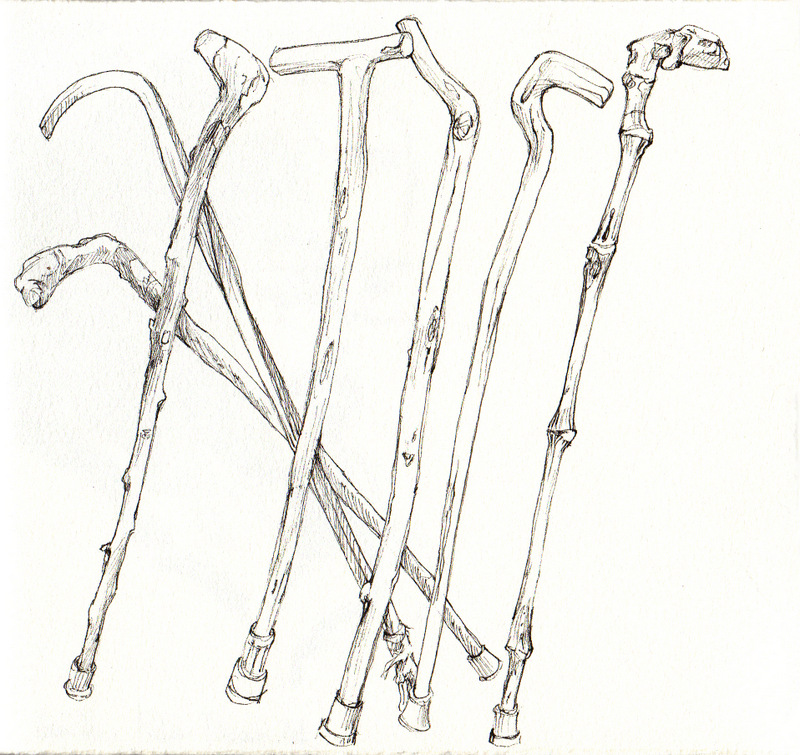
Recently, I needed to use a walker for a while, and drew it--you may have seen those posts!  Then I graduated back to my collection of canes.  They're so cool and idiosyncratic, I just had to draw them.

These were with my old standby Micron Pigma, done in the little journal Roz Stendahl made with Arches Text Wove paper...fun!

Some are mainstays, like the T-shaped one and the more iconic cane 2nd from left, and some are just too fun, like the one on the right.  Some mean a lot to me, since my husband either gave them to me or MADE them for me.

But right now I'm grateful I don't need to use them.

Friday, April 13, 2012

Working with the Pentel Pocket Brush Pen

Pentel Pocket Brush Pen Sketch and watercolor . Click on the image to view an enlargement.
I've been doing a series of posts on intermittent Fridays in which I suggest projects which can be done in an afternoon or on the weekend.

Today I posted the first in a multi-part series on getting used to the Pentel Pocket Brush Pen. If you have one of these pens but haven't used it much, or have seen people using them and wondered if the pen might be for you, check out the post and the series (there will be at least 4 more on the Pentel Pocket Brush Pen in future weeks).

I'm also hoping to get some videos up so that you can see me drawing with the pen (but International Fake Journal Month is making my life a little full right now).

You might ask yourself, "Why would I ever use a brush pen? There doesn't seem to be any control, the lines are so dark…" and so on.

It isn't for everyone. But as with any tool practice will give you greater control. I'll also show ways you can work with its lines and paint in later segments.

I believe you owe it to yourself to at least give it a try because it might just be the increase in line vocabulary for which you're looking.

I'm not in anyway connected with Pentel or anyone who sells these pens. I just like to see the happy smiles on the faces of people when they pick one up and begin to sketch with it.


Why the Pentel Pocket Brush Pen? It's got individual synthetic hairs that make up a resilient and springy tip  that allows you to have sweeping as well as dry brush strokes. One friend admitted he'd never tried the PPBP because other brush pens he'd tried had no body in the brush tip. He walked out of my studio with one and has been using it ever since. While I can't give everyone in the world one of these pens (I wish I could, but I can't) I can let people know how fun it is to use.

(Note: I have also found the tip to be long-lasting. I use my PPBP daily, sometimes for several hours at a time and my pens last a long, long time.)

Also it has rich black ink which is waterproof (immediately on most papers depending on the paper's sizing) and that means you can paint over it right away with your watercolor or gouache washes.

I have always been a rather tight and detail oriented sketcher. OK, let's just say fussy. I typically use a dip pen or a fine point pen of some sort. The switch to the brush pen was massive for me because it meant darker bold lines. But I embraced the difference because it gave me access to quick sketching on a larger scale and because it helped me hone my editing capabilities. While I have more editing work to do in my sketching (and I'll enjoy every day of it) I have found that using the PPBP has actually improved my work with other pens as well.

And it's a great way to warm up and let your hand move across the page.

For all those reasons I think you should give the PPBP a try. For the next several weeks I'll be posting a new Project Friday with different exercises for using this pen.

I urge three things on people: Chocolate Chocolate (not a typo) Cake from Cafe Latte, journaling (both written and visual), and using a PPBP. All three are great fun. It can also be argued that all three are addictive.  But the last two can only have a positive effect! I hope you'll give the PPBP a try.

Don't Be Confused: Some people are confused by the various pens that Pentel makes. Here is a post I wrote about two of Pentels brush pens: The Pocket Brush and the Color Brush. You'll find out pros and cons for both there.

At the end of last year I started using Pentel's Aquash Brush Pigment Ink Filled Brush (I know, I know, but it is what it says on the package and you have to add the Pigment Ink Filled bit because they also call their waterbrush, which is empty, Aquash). I will have something more to say about this brush pen in my series on getting used to the PPBP, but in the meantime you can read my adventures of first using it by using my blog's search engine to look for "Aquash" posts.

Sunday, April 1, 2012

International Fake Journal Month 2012 Starts Today

Fantasy person from recent regular journal,
See details in post. Click on image
to view enlargement.
Today is the start of International Fake Journal Month 2012. On Roz Wound Up I've reminded people by posting some fantasy people I've been sketching. You can see more of them there.

You can also go directly to the Official International Fake Journal Month Blog and read about the event as well as see details about this year's contests (it's a prize drawing for participants as usual).

But I wanted to write for a moment about one of my fantasy people—who is NOT in my fake journal this year—because it points to one of the benefits of participating in IFJM.

Each year in April I keep a fake journal for 30 days. I've been keeping fake journals for ages but I formalized it in 2001 and started telling students about it, and finally in 2009 created a blog just for the purpose of promoting it.

I think it's a useful activity to use to learn more about one's real journaling process. This is best accomplished by setting goals and parameters for your character. Personally I like to set a limit to the art materials and subject matter that I will use. In my regular journal life I'm all over the place experimenting—testing and evaluating. IFJM is a luxurious contrast because for 30 days I sink into a medium and an approach and allow myself time to explore a little more deeply. I could do this any time in my life, and often in my painting I'll do this type of exploration with a month long, daily painting series like my bird series which became a show 30 birds in 30 days. But each year April's IFJM makes sure I take time for my art in a way I might otherwise over look.

The lead up to IFJM is now always a little bit overly busy for me because instead of just thinking about what I want to do for my project I'm posting about the event and encouraging other folks. This year I didn't do a lot of pre-posting because I'd already (in past years) written tips about how to prep, not prep, choose a book, and so on. I was also swamped with work deadlines and family obligations.

But I was really, really enjoying working in my recent regular 8 x 8 inch (approx.) journal which I'd made with TH Saunders Waterford 90 lb. Hot Press High White watercolor paper. And because I was enjoying it I wanted to push it and see what more I could do with it in the few remaining pages. (Often my desire to explore a new paper in my test journal is overwhelmed by the reality of having to take notes at meetings and otherwise document my life.)

In the last pages of the TH Saunders Waterford journal I got out a pencil I have on hand for doing an occasional sudoku puzzle first thing in the morning when I look at the weather. (I don't normally sketch with a pencil.) 

After scribbling down a face from memory, working small and blurry with the pencil, just letting my hand get a feel for the paper (this paper loves pencil), I started dabbing on and wiping off the paint to see how tough the paper was. (It's pretty tough.) It was fun. And the fun pushed me out of my rut of thinking about the paper I was going to use for IFJM and soon I was testing and rejecting the paper I thought I would use, and making all sorts of helpful decisions. I selected my next regular journal with paper that would be useful to continue this type of experimenting, and in the process I picked the paper for my fake journal. A plan came together.

Would I have come around to fiddling with this approach if I hadn't had IFJM "hanging" over my head? Probably, but also probably not for a month or more because of the other events going on at present and which regular journal I would have selected.

So whether or not you participate in IFJM I just want to urge you today to set up some deadlines and projects for yourself that will cause you to look at your journaling process and bust out (even for a short while) of habits and approaches that you've taken for granted.

You can always return to them, they won't go away, you won't "break" anything by taking an experimental plunge. But you'll come back to your regular journal practice with freshness and a new energy, and perhaps even some new approaches to how you visualize.

Friday, March 2, 2012

Use Color Fearlessly: A Color Theory Workshop

Above: Selection of paintings from Roz Stendahl, demonstrating her approach to color using a variety of media.
August 9 through 12, 2012 I'll be teaching a color theory workshop at the Midwest Art and Lettering Retreat. This four-day event is organized by the Colleagues of Calligraphy but is open to everyone. For details about the workshop please see my blog post Roz Wound Up: Use Color Fearlessly.

Besides being open to non-calligraphers this workshop is open also to artists of all skill levels. We will focus on blending colors from a limited palette of watercolors in order to understand the relationship of the colors. Students will develop a working understanding of color through experimentation and guided exercises which are chosen to provide useful color information regardless of drawing or painting expertise. This workshop will equip students with the skills needed to develop a personalized palette. I hope you will consider spending a bit of your summer in Minnesota exploring color with me.

Friday, February 24, 2012

Tearing Paper to Make Your Own Journals

Last year I got a criticism on one of my teacher evaluation forms. (Yes it does happen.) One student wrote, "I don't know why we wasted time on learning how to tear down paper and didn't spend all the time on sewing."

Now the evaluations are anonymous but I can tell you something about this student—she already had a way to tear down paper that she liked, or she owned a large paper cutter, or she was a member of the MCBA Co-op and had access to their equipment, or she is used to taking classes where the teachers prepare all the materials in kit form (and therefore doesn't make books at home on her own because she really hasn't learned hands on all the steps).

The class however was open to students of all levels. And my approach to bookbinding is to tear your own paper without expensive equipment—something anyone can do at any level.

Frankly I can't see how you can make a book without knowing how to tear paper, so it's an essential part of the process of bookbinding to me. As an instructor I believe it's important to go over the process of tearing, and in that discussion also bring up the various qualities of the paper, and of course demonstrate the proper technique. As a time management tool it also eliminates a bottleneck of students at the cutting machines and keeps class moving more quickly than it otherwise would. It is even more important to teach this skill when a book structure requires fussy tearing of a sheet to get a page size that can't happen simply by folding in half and in half. Showing how to measure in those circumstances is an important skill to teach.

So while I'm sorry the student was frustrated and I do try to pay attention to critiques, I won't be changing my approach—it is a foundation of my philosophy.

I know a number of the readers of this blog either already make their own books or would like to make their own books. Some of you may not know how to tear down paper. Today on my blog Roz Wound Up I have posted a video demonstration of me tearing a 22 x 30 inch sheet of Folio (which is a heavy weight printmaking paper). Along with the video I have provided a few additional written tips and recommendations including links to my posts on determining grain direction and also how to fold and collate your torn sheets so that you have matching surfaces across a page spread (some papers have markedly different fronts and backs). I'll be following up with another post discussing fussy tearing.

Monday, January 16, 2012

Thoughts on White Gouache

Above: Gull Study with different whites labeled. The acrylic white
gesso was added to the background before I decided to do a gull study
on this journal page. Click on the image to view an enlargement. 
I get asked a lot about my use of gouache both in my visual journals and in my stand alone paintings. Shortly after Kate started this blog I contributed a lengthy post about using gouache—the gum arabic based, opaque watercolor. Today I posted a discussion of my use of white gouaches on my regular blog (Roz Wound Up). Based on the response I've received to my initial gouache post here I thought it might be of interest here as well.

Gouache can be a tremendously fun medium in which to work. It allows for reworking and covering and is therefore "forgiving" in ways that transparent watercolor is not. It can be used in conjunction with transparent watercolor, and in fact, if you are using a quality brand your gouache paint can be used transparently in passages within a painting where opaque passages all exist. For me the great fun of using gouache is the feel of the paint as you put it on the support (I use gouache on paper, watercolor canvas, and Claybord™). I love moving and blending the paint—seeing the strokes or not seeing the strokes as my intention directs.

Gouache has other characteristics that are user friendly—most important for me it doesn't smell (again, if you get the right gouache!). Acrylic paints, which I use for some of my stand alone paintings can be wonderful for opaque techniques and even heavy body textural techniques to which gouache is not suited. But acrylic paints all have some sort of chemical smell which bothers me. And I have to get the stay-wet palette out to use them over the course of a day or a week. With gouache you can decide on the spur of the moment to paint, get called away, and come back at any time to continue.

I use both Schmincke and M. Graham brand gouache. Schmincke has little odor at all; M. Graham smells a bit like the honey that it is blended with. Both brands are pigment without added opacifiers so when you are mixing your colors your resultant colors are rich and not muddy. Both of these brands also rewet well which has allowed me to make my own pan travel palettes of them, for use in the field. (I spritz my pans when I start my sketch and the paint is a lovely consistency when it's time to paint moments later.)

If this brief statement of gouache intrigues you check out what I have to say about white gouache over on Roz Wound Up today. The more options you have in your visual journaling tool kit the more enjoyable your experience is going to be and the more likely it becomes that you'll build a life long habit. I hope you will, gouache use or not.

Note: I use gouache fairly thickly on my journal pages when I paint with it and despite that have rarely encountered a cracking problem. I mention this so that folks new to gouache aren't scared away by comments that "gouache cracks." It certainly will if you slather it on and then keep moving the support (in this case, keep bending the page you painted on), but you will quickly discover the thickness level as you work with it. If you want additional protection for your gouache pieces in your journal I recommend you use Microglaze from Skycraft (I'm not affiliated). It is a waxy substance you gently rub into the surface of your painting. It's acid free. It has a citrus smell. When it dries it has no waxy feel. It will, however, slightly alter your colors (as any finishing agent will) so you'll want to test it first on a sample. And it alters the matte finish of gouache every so slightly; again you'll want to test a sample.  I use Microglaze to give protection to my paper beads as well.

Saturday, April 30, 2011

Roz Stendahl's workshop!

Don't forget, Roz's free Strathmore journaling workshop starts May 1!  I think you need to go here first, to register:  http://www.strathmoreartist.com/vjworkshop2011.html

As noted, she has a workshop blog, HERE, and it's going to be a lot of fun.

See you there!.

Monday, April 25, 2011

My Free Online Journaling Workshop Is Almost Here!


If you haven't already heard, I've got a 4-part visual journaling workshop coming up over at Strathmore (using their new line of journals). It's free. I did this little video for fun last night to promote it.

If the embedded video doesn't play you can see the promo here. I hope you'll join me in May.

Sunday, March 27, 2011

International Fake Journal Month Is Almost Here!


If the embedded video doesn't work you can see a flip through of my 2009 Fake Journal here on YouTube.

It's almost April and that means International Fake Journal Month (IFJM) is about to begin.

IFJM is the celebration of fake journals. Every year in April I encourage people to keep fake journals for the month. (April is the obvious choice right?)

If you don't know what a Fake Journal is, let me explain: A fake journal is a journal that is kept by a character of your creation. It is kept day, by day, as any other journal would be. The entries are dated with the date that it actually is when when it was written, i.e., today's journal entry would be marked 3/27/2011. What is fake about the journal is the fact that the character is not you, and the character is not writing about your life.

You can read more about Fake journals, as well as Historical Fake Journals and Faux Journals at the Official International Fake Journal Blog.

Each year I set up a prize drawing for participants and you'll find information on how to enter the 2011 contests in the right hand column of that blog under "Contests for 2011."

I've kept fake journals off and on my entire life. It seemed a natural outgrowth of my daily journal practice and my slightly odd sense of humor.

And I have found the practice informative and helpful, in many of the same ways that I have found my real journal keeping to be.

Just some of the ways fake journaling can benefit you include: new strategies to shut up your internal critic; new proficiencies with media; discovery of creative ruts and ways to get around them; and of course play.

Creative play is always good. It helps us get back to our real work.

If the idea of a fake journal intrigues you I invite you to check out the links to the Official International Fake Journal Blog and read more about the process. You'll also be able to view a couple of my past fake journals, as well as the fake journals of past participants. You might concoct a way to take a vacation from your journal WITH your journal, or explore issues of interest in a new way.

If you are new to journaling (written or visual) I recommend that you not keep a fake journal until you have firmly established your own journaling practice. But in the meantime there is no reason you shouldn't enjoy the posts about fake journaling and be entertained by the work of other artists trying this out.

Most of my posts on fake journaling are really about journaling in general, or rather real journaling—I'm just trying to give you some options, some ways of seeing something from a different angle. Something that you can take back to your regular journal practice to make it deeper and more satisfying because it comes from a place of epiphany.—Roz

Friday, March 18, 2011

Interview #8--Roz Stendahl!

I'm pleased to be able to share this interview with my friend Roz, a talented and generous artist if ever there was one!  I asked her to share a bit about herself, before the actual interview, so here is: 

Introduction: A Little Bit about Roz

I'm a graphic designer, illustrator, and book artist living in Minneapolis, MN. I came up to Minnesota (the thought of snow didn't scare me off) to attend graduate school (I have an MA in English). After graduation I stayed, still not put off by the snow; and I was in love, with Dick who is an engineer (and he's stuck to Minnesota like a tick in a dog's groin).

I worked at a series of jobs in publishing, until I became a production editor for a company publishing college textbooks. Production editors handle the hiring and supervising of all aspects of a book's journey from manuscript to printed form-copyediting, proofreading, illustration, photography, typesetting, and printing. During my tenure there I discovered that my favorite part of the process was design, so I started doing designs for the books I handled, with my boss' blessing (it saved him money). Eventually I went to work for myself.

I like to have a lot of projects going on at the same time, besides work projects, so I started teaching journaling and book arts classes. I was fortunate to take classes with a truly skilled bookbinder, Denny Ruud. I learned several traditional bindings from him, but more important I learned to think about the book structure, the use of the structure, and the characteristics of the component parts. My own current structures are my experimental departures from traditional bindings. They meet my own sketching and painting needs. I have enjoyed encouraging students to look at their own journaling and sketching needs and requirements to create a book that is most useful to them. I try to teach a couple classes a year to encourage the bookbinding and journaling spark in others. My blog Roz Wound Up grew out of my teaching, replacing a Yahoo list I had for past students.

Also between branching out on my own professionally and 2003 we shared our lives with two Alaskan Malamute bitches-Emma and Dottie. Dogs give us great gifts every day. For an artist one of the greatest gifts is the reality of a live-in life model.

----------------------


And now, on to the interview!

------------------


Q Have you always journaled, and when-and why!--did you start?


A I have always journaled. My mother gave me my first journal/sketchbook when I was 3-1/2 years old and we were on the President Wilson traveling from the Philippines to the US. She wanted to keep me occupied. She told me to go and note things down and sketch. So that's what I did. Or as much as any 3-1/2 year old can. Scribbles which I thought were very important and of course meant something to me. I've had diaries and journal/sketchbooks ever since.


Q What's your favorite medium, can you tell me why?


A Pen and ink with watercolor or gouache washes. I like this medium because it's a great way to sketch-the pen and ink for line and even value shading, and then if you have time, the watercolor or gouache washes for adding color. You can take time to do really detailed pieces this way, or quick thumbnail sketches which you can make color notes on with the paint, to use as references for later paintings.

I like this medium because it is portable. A couple pens and I'm all set-though sometimes I do take my dip pen and a bottle of ink out and about for the ink. I like Staedtler Pigment Liners for my fine line-sketching pens as they are waterproof when dry and also the ink doesn't have a chemical odor like other waterproof pens I've used. I also really love the Pentel Pocket Brush Pen for its bold ink lines which can be thin, fat, dense or dry brush depending on how you wield it. So I can get along with a brush pen, a regular pen (or two of different widths) and then my small watercolor palette and gouache palette-both of which hold 11 colors and are children's palettes that are about 1 x 3/4 inch. I've simply popped out the kid's colors and put in my own from tubes. I use Daniel Smith and M. Graham watercolors in the watercolor palette and Schmincke Gouache and M. Graham Gouache in the gouache palette. I chose those brands because they have quality pigments and because they all re-wet really well. I carry a Niji waterbrush to use with the paints out in the field.


Readers can see my palettes (and read about them) at
http://rozwoundup.typepad.com/roz_wound_up/2008/10/travel-palettes-for-watercolor-and-gouache.html

I think the main reason I use pen, ink, and watercolor or gouache is that they don't smear on the opposite page of a spread.

I used to do a lot of colored pencil in my journals because I couldn't find journals bound with paper compatible with wet media. Colored pencils always smeared over time in my journals and also I was always having to take a large selection of pencils with me out into the field in order to have a range to work with.

Then I started making my own journals and I didn't have to worry about paper issues. I started watercoloring over pencil lines, but something about me prefers using pen and ink. I like the finality of the lines, or rather the boldness. I don't mind that I have to find my way to the line sometimes and have other lines in the image. It's all part of the experience, a record of my seeing of something.

Of course I had those extra lines when sketching with pencil or colored pencil too as I don't erase-but those lines were more muted and easier to cover or fade out.

I will still use graphite or colored pencil for sketching upon occasion and then cover with watercolor washes. The watercolor's gum arabic holds the graphite to the page nicely. But I always end up back with pen and ink. At least if I run out of time I always have the pen and ink and no smudging-if I had sketched in pencil without the watercolor it would smudge.

More and more I care less about smudging-but instead of going back to graphite and colored pencil I find that my growing tolerance for smudged artwork has led me to the brush pen's bold lines covered with Stabilo Tones (which will smudge). (Stabilo Tones are a water-soluble wax pencil that used to be made in a 60 pencil range and now is available in about 12 colors now called Woodys. It's a delight to use and I'm enjoying every last speck of my large set. People interested in working in a similar medium with a large color choice can try out the Caran d'Ache Neocolor II line. They aren't the same in all characteristics so the fun level is a little less, but it's as close as we can get since Stabilo doesn't want to make the full range of Stabilo Tones any more.


If you go to my blog and search under Colored Pencils and Stabilo Tones you'll find lots of articles on how to apply and work with this medium, and it's pretty much transferable to the Caran d'Ache, except the blendability is a bit different (less fun), but you'll get the hang of it.

So that's where I am right now. In 10 years I may be back to graphite and watercolor. Meanwhile in the studio I seem to be veering off further into fluid acrylics. I don't try to control it, I simply follow my nose. I do believe you have to stay with a medium long enough to really explore it, to understand how it works and what applications and situations it works best for. Other than that I'm always experimenting. Odor limits my choices, I have to stay away from any art materials that have either a chemical or strong floral odor. But I still have plenty of choices.


Q What made you start the Daily Dots? How do you feel about them now? [Roz's journal pages about her beloved dog.]

A I almost always have a DAILY project going on for a YEAR at a time. I was working on "The Correspondence Lab" which was a year of writing a letter every day. (I printed special stationery and envelopes with a logo, it was great fun; and I never worried about writing a long letter-just wrote something every day for a year. I did it because I felt that email was killing my correspondence habit!)

Well as "The Correspondence Lab" was winding down I got to thinking what I would do next for a DAILY-year-long project, and of course I looked down at my feet and there was Dottie. I'd been an illustrator since before I got my first dog Emma, and I didn't draw her much, or Dottie at first, just every so often. I regretted not drawing Emma more when she was alive. She died in 1996 and the letter writing project started in 1997 and ended in 1998. My train of thought was "Don't regret not drawing Dottie." So, like most things, two thoughts crash into each other at just the right moment. I knew it would be easy to do the Daily Dots because she was right with me all the time, there was no excuse not to sketch her. So I started right after I finished the last letter for "The Correspondence Lab"-within a couple days. I'd purchased 10 or so Michael Roger Press casebound drawing books that were all covered with linen fabric (I love that sailcloth "color") and off I went. It was always about what I could do in 5 or 10 minutes. In the entire time I was working on the project I only missed about 5 days (maybe less), and those were all because of trips out of town for work. I would draw her the day I left (even if it meant getting up earlier than usual because of my departure time (that's one day taken care of), and I would draw her the day I returned, even if I had been traveling for hours and it was almost midnight! (So that was that day taken care of.) That left only the days I was actually out of town and there were few of those.


I wasn't obsessive about it-dogs have a nice way of being in the moment and that helped me be in the moment as well. And it was always meditative. She was so BEAUTIFUL. Every hair on her was lovely. Even hardened dog owner friends who never say any dog they meet is cute confessed after she died that she was lovely. Emma was striking and handsome-imposing like a lion. Dottie was simply lovely. So every drawing of her was a delight-even when she wasn't cooperating. I was learning patience with the best of teachers. And rewarded with a lot of insight into her as a dog, a presence, and a companion.


Drawing Dottie, paying so much attention to each detail of how her white eyebrows melded down into her muzzle, how her black mask changed over time to gray, how her hair changed over time, and such-it all helped me see her health-to see how she was aging. Even while the project was going on I realized it was one of the most moving experiences I'd have in my life. I had already bonded with this dog through training, through tracking training, and now I was bonding with her through observation in a quiet setting, just being. (Well she was just being, I was sketching like a fiend to finish before she decided to go "be" somewhere else.)

When the first year of the Daily Dots ended (I missed no days that year) I just couldn't stop. There wasn't any reason to stop. So I kept going. July 1, 1998 to January 26, 2003, almost 5 years. The first three years I used those Michael Roger Press casebound sketchbooks with thick drawing paper. I mostly worked in graphite or black pencil (Koh-i-nor's Negro 1, which became Cretacolor's Nero 1; or Derwent Drawing Ivory Black). Then I decided to shake it up a bit. Each new volume was one I bound with a different paper to use with a different medium-one for watercolor pencils, one on Magnani Pescia's blue paper for pencil, one with pen and ink and watercolor wash, and one with pen and ink and gouache of course.

When we got the liver cancer diagnosis I allowed myself to draw her more than one time a day (she only had about 3 months after that diagnosis, which we discovered because of another unrelated operation). I say "allowed" because throughout the project I had to limit myself to one drawing a day, not just because of pacing, but because of the realities of life. We all have work to do. I would have easily spent all my time sketching her. As it was, I filled 43 volumes with drawings of her.

How do I feel about them now? Well every friend knows that if the house is burning they need to go to that shelf, grab those journals, and leave me behind. I'll get out some how!

Seriously, they are a document of observation and attention and love, but not obsessive love. It's the type of love that sees what is. And the daily practice of sketching her taught me a great lesson about love. Ultimately, when it was time for Dottie to die, that daily drawing practice helped me let her go.

It also taught me a lot about what I take for granted in my journal practice (which is also pretty much daily) and in my drawing skills and where I want to go with my art in general. Bottom line, the Daily Dots are about gratitude. I can see that clearly as I look at them now, and could see it clearly in the final months. That gratitude fills me up the way nothing else ever had before.

I made two facsimiles of the journals early on in the project so that I could take samples to classes without taking the original books (because I didn't use fixative in the journals and I didn't want the drawings to be smeared-my students can be hard on my journals). In one of the facsimiles I wrote a little essay in which I summed it up this way: This daily drawing practice has been a tremendous gift. I've learned to see more clearly, look more closely, savor my time with Dottie, and put my life in perspective. I encourage everyone to set up their own daily adventure in observation.

The project really did change my life. My observations at the zoo, my observations whenever I drew changed, improved. The amount I drew increased across the board. I stopped working 14 hour days at the computer without drawing. In other words I learned to slow down and breathe.


In a way I also feel the Daily Dots redeemed me in my own mind. I had not drawn Emma enough and I was honoring her by drawing Dottie. Now when I keep up my daily drawing projects I'm honoring Dottie, but I'm also honoring myself and my perspective on life. I'm taking time to listen and see. This is an odd thing to say because I had been an observer and journal keeper all my life up to and including the time I had dogs and started keeping the Daily Dots. The project created fundamental life changes and I'm grateful for it every day.

It has also given me a way to deal with grief. The project in part was a way to insulate me from the grief of losing Emma and it had the exact opposite effect in that it broke me wide open. It made me love Dot all the more, and ultimately, as I said above, allowed me to accept her passing.

It has also lead me to the rather obnoxious behavior of throwing myself at my friends who have dogs, simply showing up to sketch their dogs. Happily many dogs have enjoyed coming to stay at "Spa Roz"-"where the walks are long and interesting, the treats are plentiful, and all you really have to do in return is nap a bit so she can stare at you quite a lot!"

Q How do you find time to sketch when other people need to do things elsewhere?

A If I see something that I want to sketch I just sketch it. I would love to take more time over things, and sometimes my sketches are very quick and not as "polished" as I would like, or as I am capable of. The point is it is more important for me to get a sketch in my journal (along with other notes) than it is for me to make a polished sketch, so I'm OK with rough pages. And as for the people I travel with or hang out with-well they all know I like to sketch, and most of them do too (or take really fabulous photographs). There is a wonderful accommodation that has happened in my life (and made me again, so very grateful). By showing up and being present and needing to take notes and sketch, I've attracted people to me that are OK with that, enjoy doing it too, push themselves to sketch because I am (that's their learning piece that they've chosen), or allow me the time because I am quick and it's not really disruptive. They know they can sit with me for a moment or two while I sketch something, or they can wander off and we can meet up later. It's all open, and it's all OK. There isn't a lot of ego pushing. I think this is because I have always tried very hard to be quick and also respectful of other people's time and their needs and this has been given back to me.

It really is a seamless process and I talk about this in my classes and try to create this atmosphere for my students when we sketch out in classes so that they can get a taste of it and carry it into their own lives.

As I've said, the people in my life are really interesting. So I simply love hanging out with them and seeing what they like to do and going where they like to go. I can be happy anywhere they want to go because I am with them having fun and I have my journal. So I don't have to have an agenda. (The State Fair is the only time I have an agenda: arrive at 10 a.m., spend three hours in the barns sketching hard; take a one-hour break for food and diversion; return to the barns and sketch hard. There are friends who go to the Fair with me who will meet up with me after all of this is over so we can just be at the Fair!)

[You can see Roz's 2010 MInnesota State Fair Journal HERE
 and if you go to Roz's blog and use the search feature you can find tons of posts on the state fair.]

I think if you don't have an agenda and you just draw what presents itself, and if you work quickly, and if you don't make a huge production about it, it just happens. Unfortunately some novice journal keepers do make a big deal about sketching by saying things like "Sigh, I want to sketch this so let's stay here for an hour and I'm going to get all my gear out." We don't have to wonder very hard why people stop going out with them.


So I think it helps to have no agenda and to have interesting friends and travel companions who are strong enough in their own egos and able to self-entertain and engage with the world. And you need to sketch a lot so you can be quick about it; enjoying, at the same time, whatever the result is of those quick sketching moments.

To me it is also important to make a travel journal adaptive to the circumstances of travel. If you are going to be rushing from place to place with other people you need to travel light with few supplies. My Madison journal on my websiteHERE is a perfect example of this type of strategy. I was traveling with 4 people for the first time. I didn't know how long we would stop anywhere. I carried a pen and a pad of sketching paper with me. I also had a rubbing crayon and thin Japanese paper to use for the rubbings. I gathered materials and made notes (on my pad with my sketches) during the day. At night I collaged the various elements together on cards that I had prepainted before leaving home. I tied things together with bits of color added by colored pencil. It worked really well. And when I returned home I made the case to fit the stack of cards I had created.


I think it is also key to have time alone. So when I travel, I typically get up early and sketch something before other folks are even up. Or late in the evenings when people are talking, or maybe watching TV (depending on where we've traveled), I'll sit at a table nearby so I can be companionable, and I'll sketch (and chat if it's appropriate). I'll sketch rocks, local plants, or other items I picked up earlier in the day, of if I'm really lucky and a dog is with us-you get the idea. And at other times, well if I want to sketch my food before I eat it it's just me who's going to get a cold meal, and I can eat pretty quickly so I won't hold people up. It's a combination of adaptation to the circumstances. If you don't make a big deal about it the process is seamless.


Q Does the new blog (OK, not so new, now) enhance your journal keeping, or take time away from it?

A I've found that it takes time away from my WRITTEN journal, since Roz Wound Up is really about the writing, in that I'm writing about my journal pieces, about my paintings, about my enthusiasms (biking, baking, dogs, painting, etc.). This means my written journal has really thinned down. The visual journal has stayed pretty much the same. (I know this because I page my journals and have a yearly total that I can compare to to see what's going on in my life.)

The blog has taken time away from other things however, since I don't let it take away from the visual journal. Those other things include personal projects and painting projects and house related projects-you name it. I started blogging in October 2008 and as I wind down year three, I've toyed with the idea of a brief hiatus to get some pressing deadlines finished. It's also always good for me to look at how my projects fit into my current creative needs, so it's good to take a look at where the blog needs to go in my life. I just wrote a piece about how the blog is pretty much a letter writing substitution for me and so it was very easy for me to make space in my life for it (as I'm a huge fan of letter writing).

We are coming up on International Fake Journal Month (April) and my blog for that starts to demand more time. (I post actively on that blog from March through May of the year.) People can visit that blog at http://officialinternationalfakejournalblog.blogspot.com/

This year I have quite an involved project for IFJM and I know I'll be blogging less in general. I think blogging has reached it's own level in my life. It's a combination, as I said, of letter writing with looking at process. I love to do both. Every time I think I'll just take a haitus I think of 15 things I need to post about during what would be my time off. As long as I enjoy it I'll keep it up, but no more than one post a day. I have to have time away from the computer!


Q Other thoughts? Whatever else you feel is more important, personally, to YOU...

A I say this all the time to students, and I've said it in other interviews, the most important thing to me is that I work in the journal all the time, and that I love messy, ugly pages, and experiments gone wrong. In fact if I don't have a complete disaster every five page spreads or so I really feel I'm not trying, I'm not pushing myself. The journal for me is a place to play and explore and that means every page isn't going to be pretty, but every page is going to be a learning experience for me in some way-otherwise I doubt I would have kept up with it for so long. It's fresh every day I pick it up.


Another part of welcoming "disaster" pages is that the journal is for me. Just me. I'm the audience. This is very important. If the journal were to be something to impress someone else, or communicate with someone else I just don't think I would keep it. To me, the journal, containing all the things I notice and write about and try out, is a document that captures the way my brain works, the way my creativity works. I have pages and pages where I keep swatches from paintings and photos of the progress of paintings. I have notes on why I decide to do X with this artist book binding instead of Y. I have lists on how to cut materials for classes with annotations on why I made certain choices. All those types of things I write down because I want to have them to jog my memory. And they do that sometimes, other times they are never viewed again. Whether I look at the journals or not, just looking at the shelves which hold the more recent volumes (I have to rotate earlier books into storage for space reasons so I have about 10 years worth of books at hand in my work area) makes me feel good about how my brain is functioning, how it is producing, how it is noticing, and how I'm remembering to breathe! And they remind me to be grateful.


--
Thank you, Roz, this was wonderful!  I know everyone will enjoy it...

Be sure to visit Roz's website at http://www.rozworks.com 
and her terrific blog at  http://www.rozwoundup.typepad.com/
Related Posts Plugin for WordPress, Blogger...